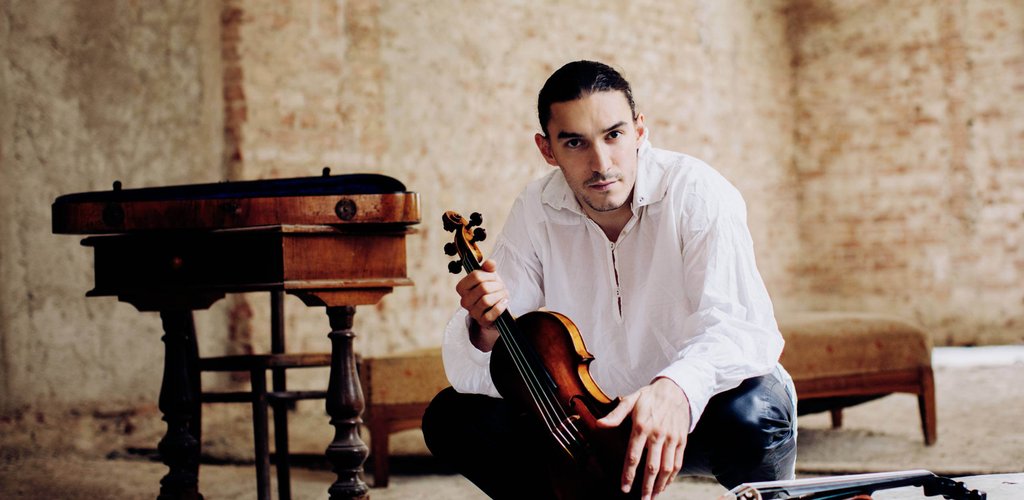
Sergey Malov, the virtuoso musician born in St Petersburg, is renowned worldwide not only for his remarkable versatility as an instrumentalist, but also as a conductor and composer. He will lead the Budapest Festival Orchestra’s Baroque ensemble on 25 and 26 April at the Liszt Academy.
I know you’re at Frankfurt Airport – may I ask where you’re heading?
I’m flying to Taiwan, where I’ll be performing Bach alongside my own improvisations. So definitely not classical music in the strict sense, but rather a combination of Baroque and contemporary music.
Why do you emphasize that it’s definitely not classical music?
I have to admit that I try to avoid anything too conventional. Of course, I have nothing against the great classics, but I’m naturally drawn to pieces that audiences do not hear every day in concert halls.
Music connoisseurs around the world regard you as one of the most versatile musicians of your generation. You play several string instruments – violin, viola, cello and violoncello da spalla – you also conduct regularly, and on top of that, you compose music in a wide range of styles. Do you have a hierarchy among all these activities?
It is difficult to say what comes first among all these possibilities. In practical terms, perhaps my concert schedule comes first. But I always try to shape it in a way that reflects what I truly love doing. Of course, that is not always possible. The best one can do is to keep striving for improvement, even within a single concert – although that, too, does not always work out perfectly.
Does that mean that people sometimes expect something different from what you yourself would like to offer?
That does happen, but I usually manage to adapt. Since you asked about priorities, one of my greatest wishes at the moment is to conduct the Budapest Festival Orchestra. Naturally, that does not depend on my wishes alone. So I’m truly delighted that this is now almost becoming a reality, because in the near future I will be leading a Baroque program with the orchestra – with an instrument in my hand. That is certainly something very, very special for me.
The Baroque program at the end of April is highly diverse. Is it difficult to bring together such different pieces so that the concert still feels coherent?
On the contrary – I think it is very easy. I already know the excellent musicians of the BFO, and I’m sure we will work together wonderfully. Two years ago, I had a truly wonderful experience with them, so I do not expect any difficulties. This kind of collaboration is part of my everyday life. If the musicians know the pieces, bringing them together should not be a problem, even if they come from very different composers. What certainly unites all the music on the program is its extraordinary liveliness and energy. A sense of joy is also a shared feature of many of the works we are performing. So the variety of styles is not a problem at all. Besides, I have great confidence in the ensemble members’ exceptional musical sensitivity, and I believe that the chemistry between us has not changed since our last meeting. If that is the case, then I am convinced there will be a great deal of joy in this concert. It is also important that although we are performing works by well-known composers, these are not the most obvious or overplayed pieces. As I said earlier, I do everything I can to avoid clichés.
Where does this strong determination come from – this desire to be different from more conventional musicians, and to resist expectations that may have become predictable or boring? When did you decide to become a musician?
The process is still ongoing, and I hope I never fully decide. I still have a great deal to achieve, and even more to learn. That is the beauty of it: there is no such thing as a perfect musician. It is wonderful to walk this endless path, knowing that it will never truly end. Of course, I have not entirely given up hope that I may be more or less suited to it.
How did it all begin?
It probably began when I moved to Salzburg in the early 2000s to study at the Mozarteum University. I learned a great deal there, not only about musical performance itself, but also through musicology, which sparked my curiosity in new ways. I read and studied extensively. But perhaps the most influential experience of all was meeting Didier Lockwood there, the world-famous jazz musician. I was captivated by his gift for jazz and by his violin playing. I got to know him personally, and we eventually became good friends. From that point on, music truly became an essential part of my life. He was a great inspiration to me.
I understand that your mother was born in a Hungarian-speaking region, and that you learned some Hungarian yourself. If so, could we speak a little Hungarian?
Of course, I’d be very happy to, although I can’t speak it perfectly. When I was little, we often travelled to Ungvár in the summer, where my mother was born. But that was nearly thirty years ago, so unfortunately I have not retained much of my Hungarian.
[Translation of his Hungarian remarks]
I truly hope that my relationship with the BFO will now grow even stronger, and that all kinds of musical opportunities will open up for me in Hungary as well. I’m very happy that we will soon meet the Budapest audience in such a distinctly Baroque setting, where Baroque gesture will also play an important role in our stage performance. This is tremendously exciting, and I’m glad that I will be doing it for the second time with the orchestra and, of course, with Sigrid T’Hooft, who knows everything there is to know about this world. In this way, we can introduce the audience to very special aspects of performance practice that they might not otherwise encounter. I’m really looking forward to the concert.
