Program
Featuring
Other information
The event is about 88 minutes long.
About the event
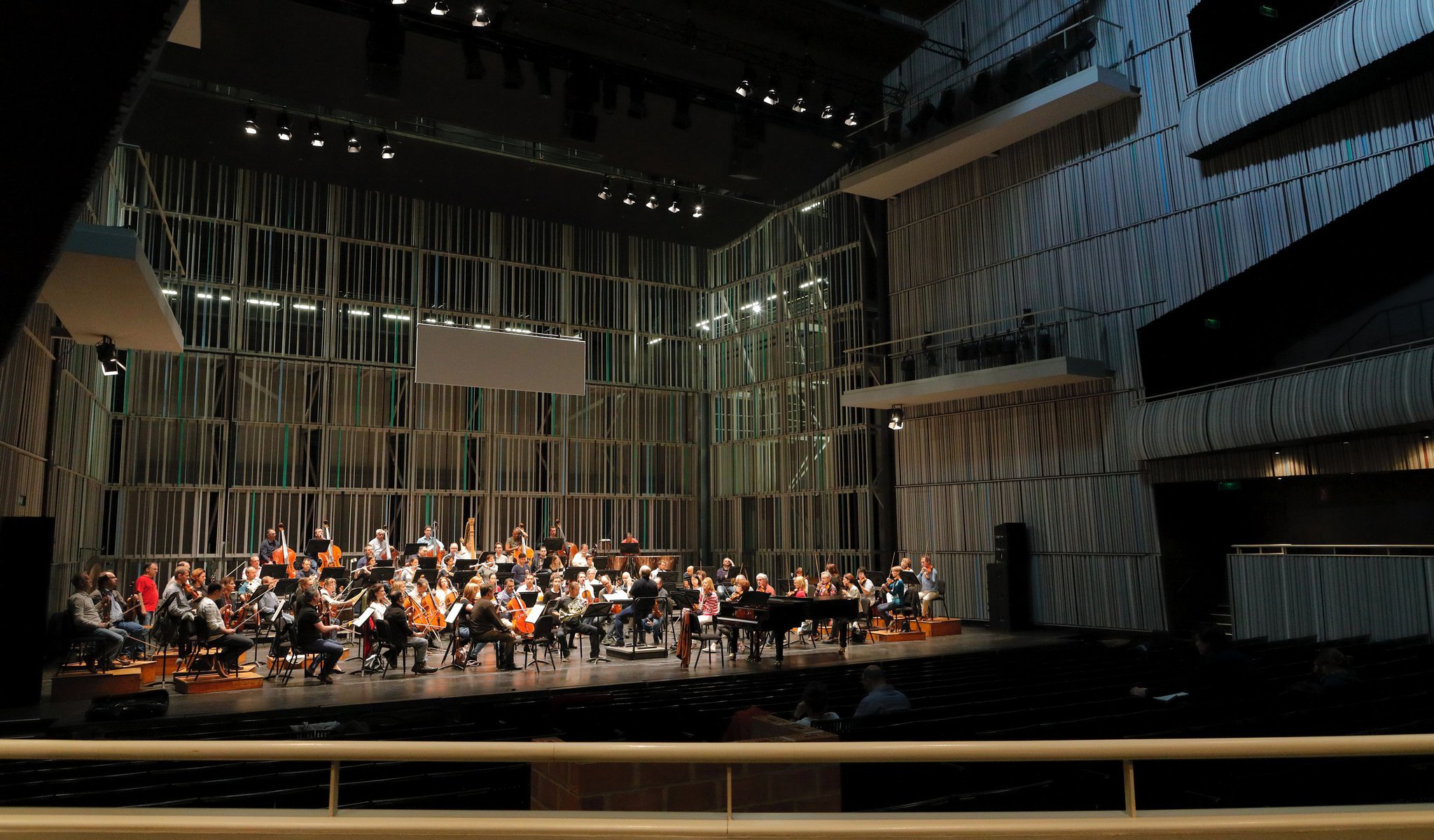
Iván Fischer and the Budapest Festival Orchestra are visiting Bruges with music from Hungary and a soloist from France. The first half of the Bartók concert will feature the composer’s Piano Concerto No. 2, the one “more pleasing in its thematic material”, which was premiered in Frankfurt with Bartók himself as the soloist. Sitting at the piano now will be Alexandre Kantorow, who has recently celebrated his 30th birthday. The pianist, a winner of the Tchaikovsky Competition was described by Classica as “the young tzar of the piano” and by Fanfare as no less than “Liszt’s reincarnation”. Bringing the talents of Liszt to a performance of Bartók seems a promising endeavor. After the intermission, the orchestra will perform one of Bartók’s most popular pieces, which reignited the composer’s creative energy after years of stagnation. The movements of the Concerto for Orchestra, each with a meaningful title, combine catchy melodies with a style distinctively identifiable with Bartók.
After his Piano Concerto No. 1 turned out to be complicated, to put it mildly (or as he put it: “its texture is slightly difficult – indeed, one might say very difficult – both for the orchestra and for the audience”), Bartók wrote its counterpart, though in many respects it can also be regarded as a continuation to the work. He thought the melodically rather pleasing composition was reminiscent of some of his early compositions. Of course, the general public now regards the two concertos as completely on the same level. One of the distinctive features of Piano Concerto No. 2 is its orchestration: while the piano is joined only by winds and percussion in the first movement, the second movement pits the piano against only strings and timpani, and the composer does not bring the instrumental groups together until the finale. Another extraordinary element is how Bartók secretly expands the traditionally three-movement genre into four movements: In the middle of the symmetrical slow movement, the Bartókian night music, there is a symmetrical scherzo. There is also no lack of quoting: in the opening movement in sonata form, the trumpet conjures up the characteristic motif of Stravinsky’s Firebird. The later theme, although resembling a folk song, is Bartók’s own melody. Eventually these themes return, although in a twisted manner, in the rhythm-centered rondo finale.
“The general mood of the work represents, apart from the jesting second movement, a gradual transition from the sternness of the first movement and the lugubrious death-song of the third, to the life-assertion of the last one,” Bartók wrote, summarizing the essence of the Concerto. However, the five movements of the monumental work follow not only an exciting linear path, but also the arch form. The piece opens and closes with movements in sonata form. Moving inward, we encounter a pair of scherzos, while the very heart of the composition is the Elegia, evoking the world of the Lake of Tears from Bluebeard’s Castle. The orchestration of the movements is also colorful, as in each one, Bartók brings an instrument or family of instruments into the spotlight, thus creating the composition’s concerto-like character. In this respect, the Giuoco delle coppie (Game of Pairs) is the most exciting movement, where each musical idea is presented by a different pair of instruments – in decreasing parallel intervals. The Introduzione (Introduction) includes several folk-song imitations. The Elegia is usually interpreted as the reflection of the composer’s homesickness. According to some scholars, the Intermezzo interrotto (Interrupted Intermezzo) is also a patriotic movement, this time a serenade disturbed repeatedly by a rude sound. The piece closes with the Finale rich in contrasts.
