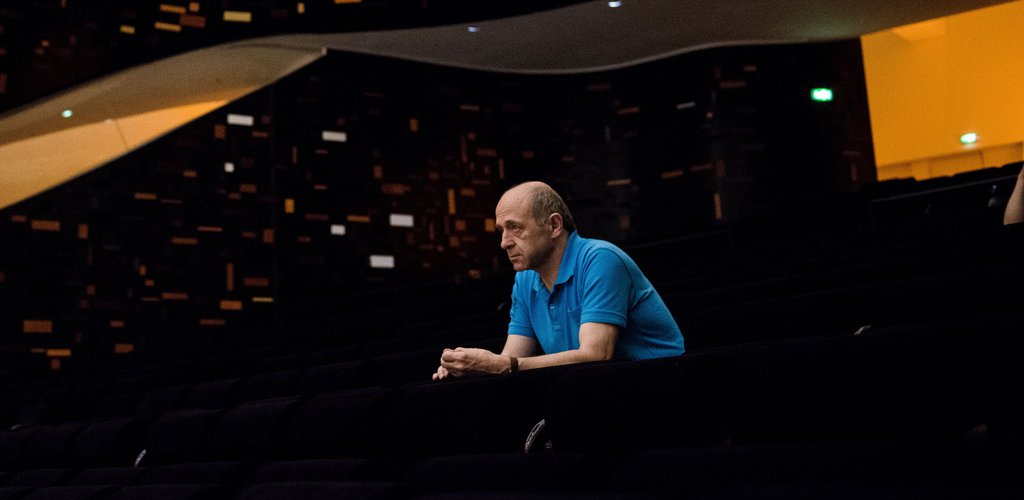
In connection with our concert in Granada, Iván Fischer answered questions from the Spanish newspaper ABC. The interview covered the art of conducting, his vocation, and the challenges he continues to face.
Do you remember what the Budapest Festival Orchestra sounded like in its very first season?
I remember that I had a very pleasant feeling about the sound in Granada. Of course, the beauty of the place helps, because it is a combination of esthetical beauty when the visual and acoustic environment is as wonderful as here.
I was recently speaking with several musicians from the Royal Concertgebouw Orchestra, and they told me that, in today's globalized world, there is a risk that major orchestras will gradually begin to sound alike, leading to a certain homogenization of orchestral sound. Do you think preserving a distinctive sound—even a local musical identity—should be a priority today?
I focus on the sound less – for me the music is more important. I mean that music has an emotional impact which is not only the sound. The timing, the inner liberty, the dynamism of an orchestral performance is more important than the sound. Like in case of a singer, the performance is more important than the beauty of the voice.
You have said before that a conductor should serve the music rather than his own ego. Can that become a daily struggle?
Not at all. That is not a struggle. A conductor must believe that the music gives an elevating experience to the listener and he or she must try to achieve this elevating experience. We are only interpreters.
What do you consider to be your greatest responsibility in the service of music?
To make people better. To serve peace and tolerance. To help people to understand themselves better.
We tend to think of a conductor as someone who speaks, indicates and makes decisions. But how much of your work actually consists of listening?
Some decisions are the same with each orchestra and each hall. But there are decisions which reflect what the orchestra can do and how I hear the sound of a hall. So, for example, if the tempo is very fast, it is great with certain orchestras and in certain music halls. But it is possible that I reduce the speed if an orchestra needs more time to play it well or if the sound has long echoes. So, I listen to the result and adapt.
Does truly listening require a certain kind of inner silence?
Yes, in the meaning that you have to be open. If you have a completely preprogrammed performance in you before you start to work with an orchestra, you will be less flexible. But if you have an inner silence and simply listen to what you get, you are freer to form a good performance.
Do we conduct the way we are? In other words, does a conductor's inner life inevitably find its way into the music they make?
To a certain extent yes. We are interpreters, interpreting the composer’s ideas. Like filters, we let the music go through our own personality. So, the result will sound like we are. But if this filtering is too strong, the conductor becomes too important, too ego centered.
When you stand on the podium, you need enough confidence to lead an orchestra towards a particular sound, but also enough humility to know that you do not possess the absolute truth. Is it easy to find that balance?
Very easy. I am not perfect, but I don’t mind, I don’t want to be perfect. I am not as good as Gustav Mahler, but I am better than many conductors I have heard. It is alright.
When you look back, do you think you conduct differently because you have changed as a person, or simply because you have gained more experience?
It is probably a combination.
After a lifetime devoted to music, is there still a question about conducting that you have not yet been able to answer?
Oh, yes, many questions. I can imagine much better teamwork between a conductor and an orchestra. For example, doubts could play a bigger part. Most orchestras like conductors to be convinced and convincing. But I think it would be great if a conductor came in in the morning and said: Today I would like to work on the doubts I have about this work.
Are there works that you still approach with a sense of awe?
Yes, there are. Schumann is very special and difficult. I think I found a key to the third symphony, but not yet to the others.
Can a conductor ever hide behind the baton, or does the music always reveal who they truly are?
It reveals. In every moment. Even if I want to hide behind the composer, it never works completely. Like an actor is also a combination of the role and himself.
How much can the historical moment shape a musical performance? One thinks, for example, of Fidelio at the Salzburg Festival shortly after the Second World War, when the story of liberation from tyranny seemed to resonate profoundly with the orchestra, the singers, the conductor and the audience alike. Have you ever conducted a performance that was deeply influenced by a major historical event, whether hopeful or tragic, in a way that left a lasting imprint on the music itself?
In the 90’s, during the Balkan war, I invited Serbian, Croatian and Bosnian choruses to sing Beethoven’s ninth symphony together.
It was unforgettable.
It may sound idealistic to think that music can save the world. Dostoevsky famously wrote that beauty would. Perhaps not save it, but do you believe music has the power to reconcile us with what is broken? With what is wrong?
I think it will help. For example, truth is lost because of the internet, social media, and AI. But an orchestra really plays the truth, we don’t play fake Beethoven, or fake Mozart. And the audience trusts this. We could become the guardians of truth.
We live in a world of constant stimulation and instant consumption. What can a symphony concert still offer that cannot be found anywhere else?
Truth.
The Spanish-language article based on the interview is available here.
