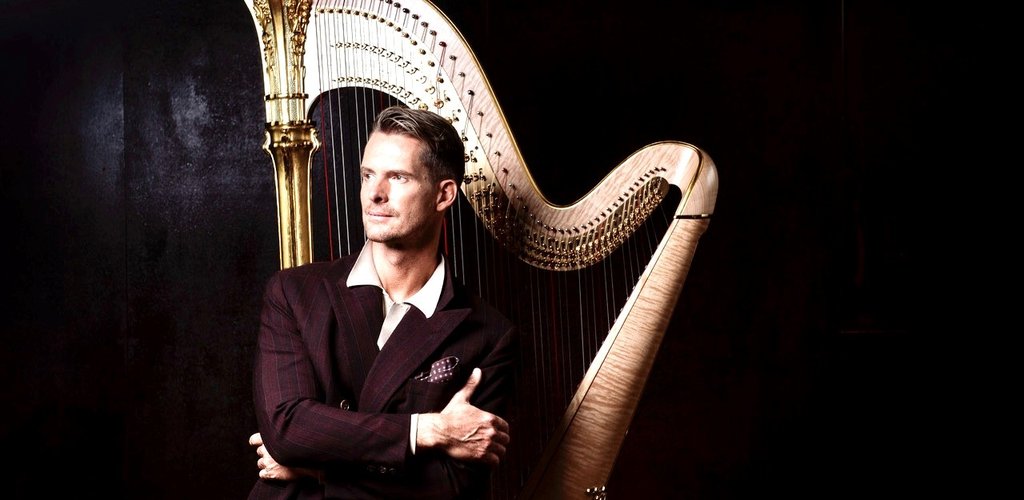
He was the first French musician in the Vienna Philharmonic, studied economics, and loves geopolitics. Today he is one of the world’s most renowned harpists, whom Budapest audiences can hear next on December 2, 3, and 6 as the soloist of the Budapest Festival Orchestra. At Müpa Budapest he will perform one of his favorite pieces, the Harp Concerto by the Argentine composer Alberto Ginastera. An interview with Xavier de Maistre.
I wondered how to explain why an eight-year-old boy would suddenly decide to play the harp. It’s such a huge instrument, bigger than an adult. How did you come to this decision?
X. M.: Actually, it happened by accident. My parents enrolled me in music school, and there I unexpectedly met a very nice teacher who happened to be teaching her students to play the harp. I liked her so much that I wanted to start learning from her, and of course on the instrument she was a master of. So first I fell in love with the harp teacher, then with the harp.
Were your parents closely involved in music? Is that why they enrolled you in music school?
X. M.: No, no one in my family was a musician. But they were convinced that learning music was important for a good education. That's why my mother insisted that I attend music school.
What was it like when you first saw this huge, beautiful instrument as a little boy?
X. M.: I liked it right away, and my teacher encouraged me because she thought I was talented. I had quick fingers and learned very quickly. Once I had learned to play the harp to some extent, I really enjoyed knowing something that my peers didn't. Somehow, I felt that I didn't want to learn an instrument like the other children. I was proud to be learning something more original. And pretty soon I felt that the harp was my instrument.
Did you want to be a famous musician when you were young?
X. M.: The truth is that my teacher told my parents that she thought I was very talented and that I had a special ability for playing the harp. My parents told me this. I loved playing the harp, and it occurred to me that it could be a good opportunity for me in the future. But my parents wanted me to study something more serious because they were afraid that if I became a musician, I wouldn't be able to make a living. So I enrolled in a political science and economics program and enjoyed studying these subjects in London. But I couldn't touch my harp for six months, and I missed it terribly. That's when I decided to try to become a professional musician. From then on, I regularly auditioned for famous orchestras, and finally got a job in Munich with Bavarian Radio under Lorin Maazel. That's how it started.
I imagine that meeting Maazel must have been very important for your flourishing career.
X. M.: Yes, of course. Lorin Maazel was an extremely impressive man. He had a wealth of experience. He had played in many great orchestras. He was world-famous, so I was very nervous when I first met him. But he accepted me immediately and supported me with extraordinary dedication. That was a huge inspiration. And in fact, he recommended me to the Vienna Philharmonic when a position became available there.
I understand that it was a great honor at that time to be hired by the Vienna Philharmonic.
X. M.: Yes. I was the first French musician to join the Vienna Philharmonic. It was a kind of childhood dream, because I watched the New Year's concert on TV every year. And I really thought that one day I would like to be there too. So it was an unimaginably great joy for me. My dream came true. When I got this job, I also thought that this was the best I could ever achieve in an orchestra. Because when you play with the Vienna Philharmonic, you are actually employed by the Vienna State Opera. That meant I could play in many operas. And in operas, the harp parts are usually much more interesting than in the symphonic repertoire. When we play symphonic repertoire, we spend a lot of time waiting, because the harp doesn't feature much. In operas, the harp is a much more important instrument. For example, there are many harps in Puccini, and in Richard Strauss, Wagner, and all ballet music. So it was a much greater challenge for me. Plus, I love singing voices. For me, the human voice is the most beautiful instrument. So I really enjoyed my years in Vienna.
Did you ever think about going into politics, economics, or something similar?
X. M.: I'm still very interested in politics. I read the newspapers every day, both offline and online. I'm particularly interested in geopolitics and everything that's happening in the world. And I think studying politics has helped me a lot in understanding how to promote and develop a project. What I learned in London is still useful to me today. I think I received a very good education. Incidentally, I am very happy that my daughter is studying the same thing I did back then. I can help her a lot and share my interests with her, which is a wonderful feeling.
Is she attending the same school in London?
X. M.: Yes, she studied at the same school in Paris, and this year she is also attending King's College in London.
I understand that you have played with the world's top orchestras in almost every country, from Japan to the United States and Europe. You also teach in several places. Your life must be quite busy.
X. M.: Yes, that's right. I travel and work a lot. Well, I used to give master classes, but now I only teach in Hamburg. I have my own class there, and I try to focus exclusively on these students because I don't have much time.
Is it possible to explain to someone who only enjoys listening to the harp but doesn’t play it what matters most in the instrument and in harp playing? What should a layperson focus on? We do know one thing: it has a lot of strings.
X. M.: There are indeed many strings on the harp, 47 to be precise. But just as important is the fact that it has seven pedals. We use the pedals to produce all the semitones. Perhaps you could imagine the strings of the harp as the white keys of a piano, and the pedals as producing the sounds of all the black keys. This naturally requires very good coordination, because we use the pedals to change the harmonies, and if we press the wrong pedal, we play the wrong harmony and everything goes wrong. This is the source of many problems associated with the harp. So it is a very complicated instrument in terms of memory and coordination.
This isn't the first time you play in Budapest, is it?
X. M.: No, no, I've played a few times at the Liszt Academy of Music. Most recently with the MÁV Symphony Orchestra. But this will be the first time I will play with the Budapest Festival Orchestra. I'm very excited because it's a very famous orchestra. I love Hungarian audiences. They are very warm and they applaud in a very special way. So I'm excited to be back. And it's also great that I get to perform one of my favorite pieces, Alberto Ginastera's Harp Concerto.
Could you talk about Ginastera and his harp concerto? Why did you choose an Argentine composer, and a piece that is unusual for us?
X. M.: It's true that this harp concerto is very different from what one would expect from the harp. When we think of the harp, we think of glissandos and arpeggios. This concerto, however, is primarily written in a percussion style. It is very rhythmic music. Many elements of South American and Argentine folk music can be heard in it. I think it is a very interesting piece. I have performed it many times, because it is one of my favorite pieces for solo harp and orchestra.
Ginastera is considered by experts to be a master of nuances.
X. M.: I would say that he is a master of the smallest elements of musical performance. And above all, a master of colors. He used the harp in a very special way. With many different dynamics and by plucking the strings in different ways, which results in very different sounds. And I think that's what makes this concerto so interesting. Although the sounds are unusual, it has now become a classic concerto. When it was composed, it was considered very avantgarde. Today, many composers draw inspiration from it. It does not try to imitate the Western style. It has integrated many Latin American rhythms and melodies.
David Robertson is the conductor of this concert, with whom you have worked several times.
X. M.: Yes, David Robertson is a very experienced conductor. I have played with him several times. He is a very warm-hearted person. He is great to work with, especially as a soloist, because he knows how to accompany and is a very supportive partner. So I am really looking forward to playing with him on my debut with the BFO.
Interview taken by Júlia Váradi.
